Zit Journal
Solar Panel Price in Nigeria: What You Get at Each Level
Solar panels on Zit range from ₦14,000 to ₦2,657,078 across 29 in-stock items. Here is what the cheaper options give up, what the middle bands add, and where installation fits in.
Zit Journal
Solar panels on Zit range from ₦14,000 to ₦2,657,078 across 29 in-stock items. Here is what the cheaper options give up, what the middle bands add, and where installation fits in.
A solar panel in Nigeria currently costs between ₦14,000 and ₦2,657,078 across the 29 in-stock items in Zit’s Solar Panels section. The cheapest option is a small solar lamp, while the higher end includes a lithium battery, so the price difference reflects very different jobs rather than one panel simply being better than another.
This guide uses a sample of products across that full range. It is for a buyer deciding whether to power a small light, support a rechargeable fan, or start a larger home solar setup in Nigerian conditions.
At ₦14,000, the Binatone Solar Pocket Lamp | LA-105 is the clear low-cost entry point. It has a 0.4W mono-crystalline solar panel, a 3.7V 300mAh LiFePO4 battery and one LED. Its stated working time is three hours on High at 40LM or six hours on Low at 20LM.
That makes it suitable for basic personal lighting, not for running household appliances. The trade-off is straightforward: you spend less because you are buying a compact lamp with limited light output and battery capacity, rather than a panel intended to form part of a wider power system.
Its charging time is listed as four to five hours under sufficient sunlight. That matters in a Nigerian home where the lamp may be charged outdoors during the day and used during a mains outage, but it is not a substitute for a system designed around a fan, television, refrigerator or multiple rooms.
The next step in the sample is the Duravolt 30W 15v Solar Panel at ₦35,000. Its product information describes it as a 20-watt solar panel for charging fans, lights and other small electronic gadgets, with a 15V maximum power voltage and 1.33A maximum power current.
This is where buyers should stop comparing only the number on the price tag. A small panel can make sense if your target is a rechargeable fan or a few lights, but it is the wrong choice if you expect one panel to support a full apartment. Check the requirements of the equipment you already own before paying.
For a flat with limited balcony or roof space, a smaller panel may also be easier to place and handle. However, the installation still needs to account for where sunlight reaches the panel, how cables enter the room, and how the setup will be protected from dust, rain and accidental movement.
The sample moves to ₦86,510 for the 200W/190W Monocrystaline Watts Solar Panel. Its listing identifies the module as AF-200W-MONO and states a 25-year life span, with an advanced encapsulation material and multi-layered sheet laminations.
At ₦117,500, the AFRICELL 400W Watts Solar Panel is a larger step up on the listed output. The product details give its size as 1640×992×70MM and weight as 18.5KG. The AFRICELL 450W Watts Solar Panel is listed at ₦128,800, with the product page identifying the module as AF-480W-MONO and giving the same stated size and weight.
These prices show why a buyer should look at more than the word “solar”. A panel with a higher stated wattage is physically a more substantial purchase and may be more appropriate for a system with several loads, but it also needs suitable space, mounting and supporting equipment.
For a Nigerian home, the right question is not simply “what is the biggest panel I can afford?” Ask what you want to use during a power cut, how much roof or balcony space is available, and who will install and connect the equipment. A panel that does not match the rest of the system can leave you paying for capacity you cannot use effectively.
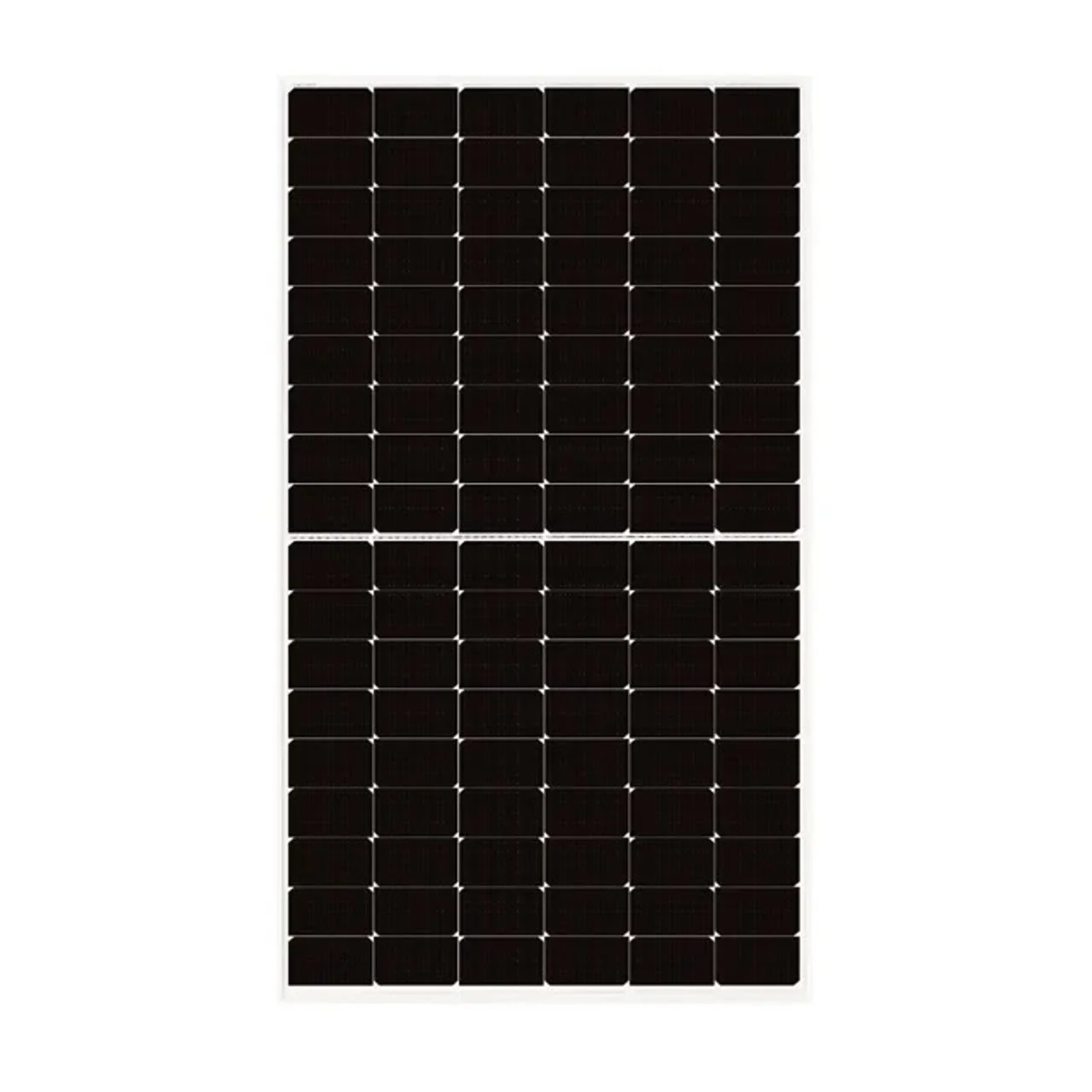
The higher panel prices in this sample include technology and construction details that are not present in the lamp category. The Jinko 620W Half-Cut Bifacial Monocrystalline Solar Panel | 620N-66HL4-BD costs ₦145,000. Its listing highlights N-type monocrystalline construction, half-cut cells and bifacial technology that captures sunlight from the front and rear sides.
The Felicity 350W Solar Panel Monocrystalline is ₦153,245. Its listing gives a 36V specification, 72 cells, dimensions of 1956×992×40mm and a weight of 22.5kg. That information is useful when planning delivery, mounting and the amount of space available on a roof.
The Sunfield 450W Half Cut Monocrystaline Watts Solar Panel costs ₦172,700. Its listing mentions mono cells, waterproof lamination, a five-year product guarantee, a power warranty of 90% for the first 10 years and 80% for the next 15 years.
At ₦216,274, the Felicity Half cut 540W Solar Panel Monocrystalline | FL-MSD-540W is the most expensive panel in this sample. The stated dimensions are 2279×1134×35mm, and the listing describes a half-cut single-glass module with multi-busbar PERC technique.
The extra money at this level is going into a larger stated output, panel construction and features such as half-cut, bifacial or N-type technology. It is not automatically the right purchase for every buyer. A small apartment with one rechargeable fan has a different need from a home building a larger backup system.
The full Solar Panels section reaches ₦2,657,078 because it includes more than individual panels. The Foresolar 10KWH Lithium Battery is listed at that price, and its product page categorises it among lithium batteries.
This is an important price-guide distinction. You should not compare a ₦14,000 solar lamp directly with a ₦2,657,078 lithium battery as though they are competing versions of the same product. One is a ready-to-use light; the other is a major storage component for a larger solar arrangement.
If your goal is dependable backup through unstable mains and generator changeover, the battery and other supporting equipment deserve as much attention as the panel. The panel produces energy, but the complete setup must be planned around what you want to run and when you want to run it.
When you move up the price bands, your money is paying for several different things: the intended use, stated output, physical size, cell and panel design, and the equipment’s place in a wider system. Brand and product construction also differ across the sample, from the Binatone lamp to Duravolt, AFRICELL, Jinko, Felicity and Sunfield panels.
Installation is a separate practical decision. The installer may need to assess the roof or balcony, position the panel, route cables and connect it to the rest of the setup. Do not assume that buying the panel price covers this work, and do not choose an installer based only on the lowest charge.
Nigerian weather should shape that conversation. Dust and harmattan can affect how often the panel needs attention, coastal humidity makes placement and protection worth discussing, and heat means the installation should not be treated as an indoor appliance purchase. In an apartment, also confirm that the landlord or building management permits the proposed mounting arrangement.
The prices quoted here are the prices listed on the product pages at the time of writing. Prices can change, so the linked product page or the Solar Panels section always shows the current figure.
Compare the full range of solar panels and related equipment on Zit’s Solar Panels section before you buy.
No comments yet. Be the first to share your thoughts!
Sign in to leave a comment and engage with the community.
Chat with us on WhatsApp!
Loading…