Zit Journal
Iron Price in Nigeria: What Each Price Band Buys Right Now
Iron prices on Zit range from ₦16,500 to ₦95,000 across the Irons & Ironing Systems section. Here is what changes as you move from a basic dry iron to higher-priced steam models.
Zit Journal
Iron prices on Zit range from ₦16,500 to ₦95,000 across the Irons & Ironing Systems section. Here is what changes as you move from a basic dry iron to higher-priced steam models.
Iron prices in Nigeria range from ₦16,500 to ₦95,000 across Zit’s Irons & Ironing Systems section. The cheapest option is a basic dry iron, while spending more can take you into steam irons with features such as steam bursts, self-cleaning and vertical steam.
This is a price guide, not a claim that the most expensive iron is best for every home. If you only need to press a few clothes occasionally, the lowest band may be enough. If you iron school uniforms, office clothes or stubborn creases regularly, paying more for steam functions may make more sense.
The full section currently runs from ₦16,500 to ₦95,000. The products below are a sample spread across that range, rather than a complete list of every item available in the section.
| Price band | Example | What it offers |
|---|---|---|
| Entry level | Qasa Dry Iron | QDL 2288C — ₦16,500 | Dry ironing with an adjustable thermostat and 1200 W power consumption |
| Lower-mid range | Maxi 2200W Steam Iron | Maxiiron2200C — ₦25,500 | Steam ironing, a 110 g steam burst and a self-cleaning feature |
| Mid range | Binatone 2200W Steam Iron | SI-2225 — ₦35,000 | Continuous adjustable steam, steam boost, a 250 ml water tank and self-cleaning |
| Upper-mid range | Rite-Tek Steam Iron - Model ST-795 (3000 W) — ₦51,600 | Steam and dry functions, focused steam burst, anti-drip, anti-calc and self-cleaning |
| Top of the sample | KENWOOD 2600W STEAM IRONMODEL NUMBER:STP 75 — ₦95,000 | Steam and dry ironing, adjustable temperature control, steam burst and vertical steam |
The prices above are the ones listed on the product pages at the time of writing. Prices can change, so the linked product page always shows the current figure before you buy.
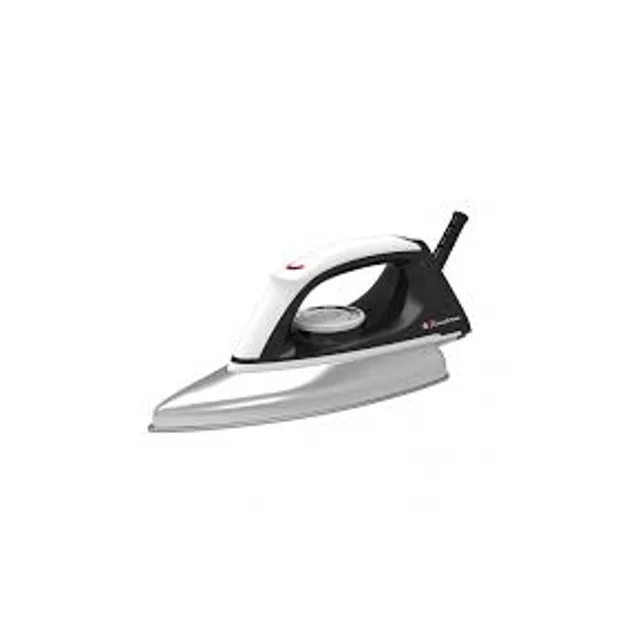
The Qasa Dry Iron | QDL 2288C is the clear budget choice at ₦16,500. Its listed type is dry iron, so it does not offer the steam functions found on the Maxi, Binatone, Rite-Tek and Kenwood examples.
That is the main trade-off, rather than an automatic sign that it is a poor buy. A dry iron can suit a buyer who wants straightforward pressing and does not need a water tank, steam burst or self-cleaning function. The Qasa also has an adjustable thermostat knob, giving you temperature control rather than a single fixed setting.
The product listing gives its power consumption as 1200 W. That figure is worth checking against the power arrangement you intend to use, particularly if you iron during generator changeover or on a supply where several appliances may be running at once.
Choose the cheapest option when your priority is the lowest listed price and basic dry ironing. Do not choose it expecting steam assistance for stubborn creases, vertical steaming or the other functions listed on the more expensive models.
The jump to steam begins with the Maxi 2200W Steam Iron | Maxiiron2200C at ₦25,500. Its listing includes a 110 g steam burst and a self-cleaning feature, so the extra money buys more than a different appearance. It is the more sensible direction for a buyer who regularly deals with creases and specifically wants steam.
The Maxi 2400W Steam Iron | Maxi1100C-Pv is listed at ₦27,000. The Binatone 2200W Steam Iron | SI-2225 moves to ₦35,000 and lists continuous adjustable steam, a steam boost, fine water spray, overheat safety protection and a 250 ml water tank. It also lists a ceramic non-stick soleplate and self-cleaning for calc removal.
These examples show why the middle of the price range deserves attention. You are not simply choosing between cheap and expensive. You are choosing which steam controls and maintenance features matter for the way you iron.
If your clothes are ironed on a table in a small flat, a standard steam iron may be enough. If you want the option to work on hanging clothes, check the individual product listing for vertical steam rather than assuming every steam iron has it.
At ₦44,000, the Binatone Super Dry Iron | DI-1265 takes a different route from the steam models. Its listing focuses on an extra-heavy dry design, a deluxe metal body, a polished soleplate, a cool-touch handle, variable temperature control and a pointed tip for tricky areas.
This is not the right upgrade if what you want is steam. It may be the right comparison if you prefer a dry iron and value the listed heavy metal body and pointed tip. The choice is about ironing style, not just paying more for a higher number.
The Rite-Tek Steam Iron - Model ST-807 is listed at ₦45,150. It lists 2600 W power, steam burst and continuous steam, anti-drip, anti-calc, self-cleaning and a ceramic soleplate. The Rite-Tek Steam Iron - Model ST-795 (3000 W) and Model ST-790 (3000 W) are each listed at ₦51,600, with steam and dry functions and features including anti-drip, anti-calc and self-cleaning.
For a buyer who irons often, these listings make the upper-mid range easier to justify: the features are aimed at crease removal, water control and maintenance. Still, higher wattage should not be treated as a guarantee that a model is the right match for your home’s electricity supply.
The KENWOOD 2600W STEAM IRONMODEL NUMBER:STP 75 is listed at ₦95,000, the top of the sample and the highest point of the section’s stated range. Its listing includes steam and dry ironing functions, adjustable temperature control, a non-stick soleplate, steam burst and vertical steam.
This is the wrong buy for someone who only wants occasional basic pressing. The Qasa dry iron costs considerably less and covers the basic dry-ironing use described on its listing.
The Kenwood becomes more relevant when you will use steam and want vertical steam as part of your routine. That could matter in a home where ironing space is limited, but check the product details and your preferred method before paying for a feature you may not use.
Power is part of the buying decision in Nigeria. The sample includes a 1200 W dry iron, 2200 W and 2400 W steam irons, 2600 W models and 3000 W models. Compare the listed wattage or power consumption with the supply you plan to use, especially when mains power is unstable or an iron will run during generator changeover.
Steam models also introduce water into the routine. If you live near the coast or in a humid home, storage and handling deserve attention. In dusty or harmattan conditions, features such as self-cleaning, anti-calc and anti-drip may be more useful to you than a purely cosmetic upgrade, but only choose them where they are actually listed for the model.
None of these listed irons requires a separate installation service in the product information provided. Your practical costs are therefore more about choosing the appliance, providing a suitable ironing surface and using the iron with the power arrangement and care routine that fit your home. Do not pay extra for an assumed feature: verify it on the product page.
For most buyers, the lower-mid and mid-range steam irons are the most balanced place to compare. The cheapest dry iron is the value choice for simple use, while the top-priced Kenwood is a specialist purchase rather than a default recommendation.
Compare the complete range of irons and ironing systems on Zit before you decide: shop irons and ironing systems.
No comments yet. Be the first to share your thoughts!
Sign in to leave a comment and engage with the community.
Chat with us on WhatsApp!
Loading…